
Where to Find It
Your cancellation policy is set per property. Go to Property > Policies > Cancellation Policy and click the row to open the settings drawer. You’ll see a list of policy options with radio buttons. Select one, hit Save, and it syncs to your connected channels.
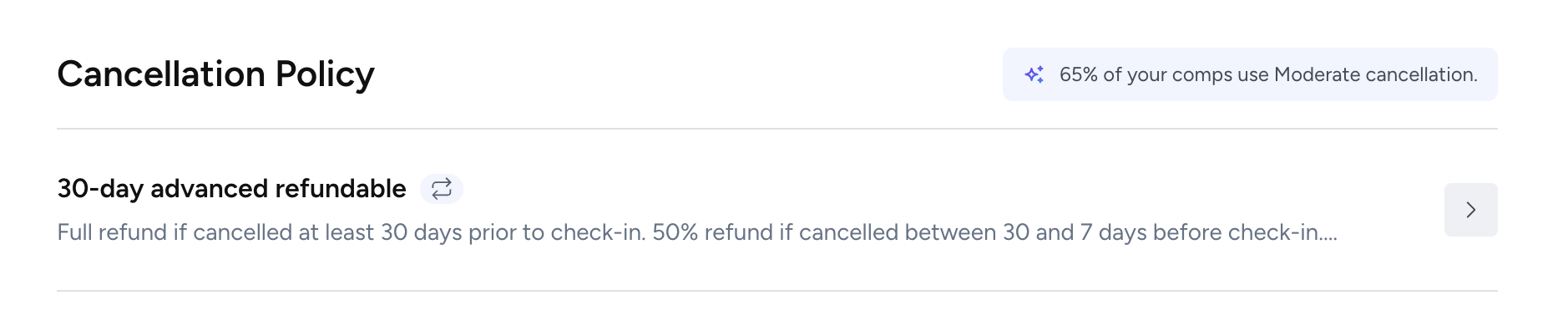
If you’re on the Amplify plan, you’ll also see a comp insight badge showing what percentage of your competitors use each policy type. This can help you benchmark your choice against your market.
The sync icon next to the setting indicates that this setting can sync to Airbnb if you’re on Full Sync. If you’re on Basic Sync, the cancellation policy applies to your Futurestay direct booking site only and you’ll manage your Airbnb cancellation policy separately in Airbnb’s dashboard. For GVR listings, guests book through your direct booking website, so your Futurestay cancellation policy is what they see.
Your Options
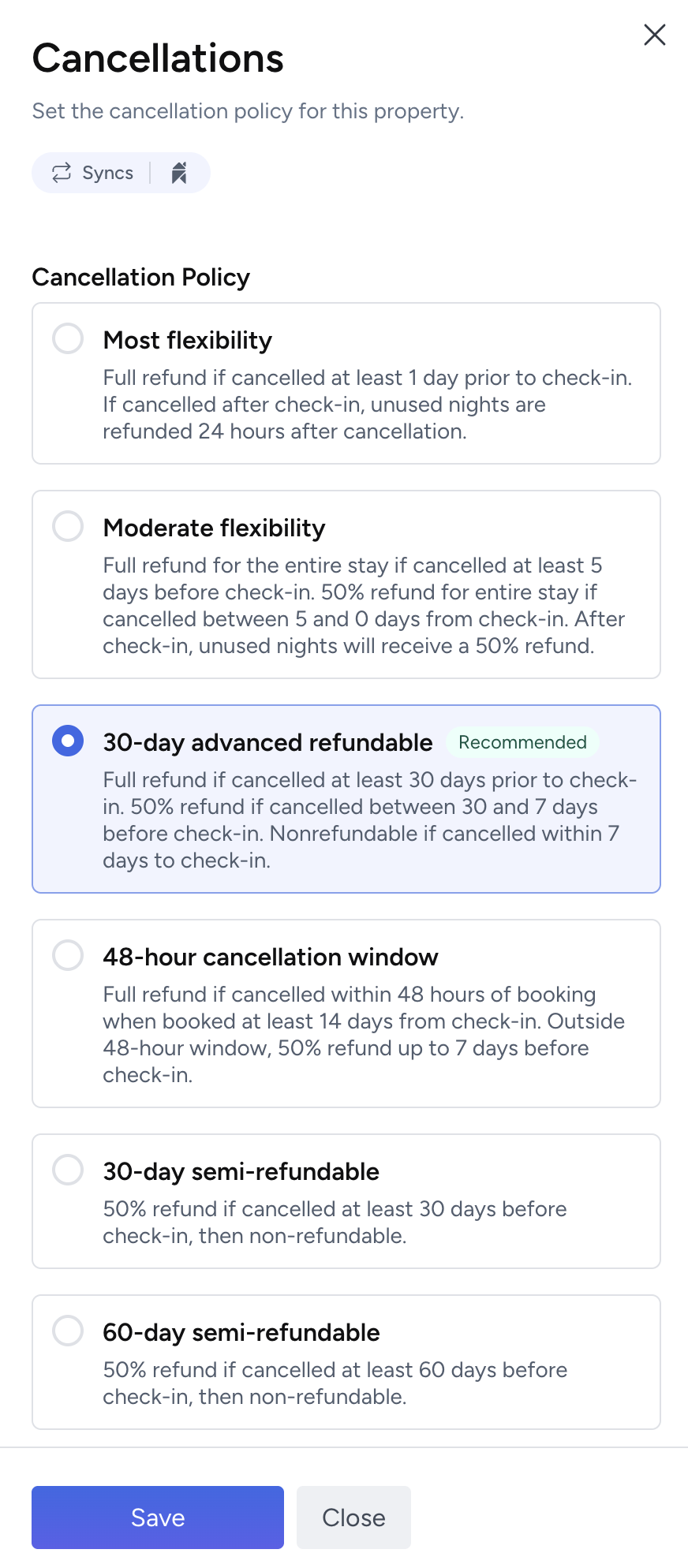
Futurestay offers five cancellation policy tiers. Each one balances guest flexibility against your revenue protection differently. Here’s what each one actually means for you and your guests.
Most Flexibility
Full refund if cancelled at least 1 day prior to check-in. If cancelled after check-in, unused nights are refunded 24 hours after cancellation.
Best for: New listings building reviews, competitive markets where you need every booking advantage, or shoulder/off-season periods when rebooking a cancellation is unlikely. This is the most guest-friendly option and will give you the strongest conversion rate.
The trade-off: You’re exposed to day-before cancellations. In high-demand periods, this is fine because you’ll rebook quickly. In slow periods, the risk is low anyway since the booking might not have happened without the flexibility.
Moderate Flexibility
Full refund for the entire stay if cancelled at least 5 days before check-in. 50% refund if cancelled between 5 and 0 days from check-in. After check-in, unused nights receive a 50% refund.
Best for: Most properties in most markets. This is a solid default that gives guests reasonable protection while discouraging last-minute cancellations. The 5-day window gives you a realistic chance to rebook.
The trade-off: You may lose some bookings to competitors offering “Most Flexibility,” but the 5-day buffer protects you from true last-minute drops.
30-Day Advanced Refundable (Recommended)
Full refund if cancelled at least 30 days prior to check-in. 50% refund if cancelled between 30 and 7 days before check-in. Nonrefundable if cancelled within 7 days to check-in.
Best for: Properties with strong demand, higher nightly rates, or longer minimum stays. The 30-day window gives guests confidence when booking far in advance while protecting you from cancellations that are too late to recover from. Futurestay marks this as the recommended option.
The trade-off: Some guests booking less than 30 days out may hesitate, knowing they’re locked in. This is less of an issue for properties that book well in advance.
48-Hour Cancellation Window
Full refund if cancelled within 48 hours of booking, when booked at least 14 days from check-in. Outside the 48-hour window, 50% refund up to 7 days before check-in.
Best for: Hosts who want to give guests a “cooling off” period right after booking without leaving a long cancellation window open. This works well for impulse bookings and event-driven markets where guests book quickly but sometimes reconsider.
The trade-off: The 48-hour window only applies when the booking is made 14+ days out. Last-minute bookings don’t get the grace period, which can confuse guests if they don’t read the fine print.
30-Day Semi-Refundable
50% refund if cancelled at least 30 days before check-in, then non-refundable.
Best for: High-value properties, peak season bookings, or unique/destination properties where a cancellation is very hard to rebook. This is a strict policy that still gives guests something back if they cancel well in advance.
The trade-off: This will reduce your booking conversion rate. Only use it if your property’s demand is strong enough that the lower volume doesn’t hurt overall revenue.
60-Day Semi-Refundable
50% refund if cancelled at least 60 days before check-in, then non-refundable.
Best for: Luxury or destination properties with very long booking windows and high nightly rates. Guests booking a $500+/night property 6 months out expect some level of commitment from both sides.
The trade-off: This is your strictest option. It will meaningfully reduce booking inquiries. Reserve it for properties where demand justifies it.
Which One Should You Pick?
If you’re unsure, start with 30-Day Advanced Refundable (the recommended default). It strikes the best balance for most properties. You can always adjust seasonally, going more flexible during slow periods and tightening up when your calendar fills easily.
For a deeper dive into how cancellation policy affects your revenue, booking volume, and channel ranking, read How to Choose the Right Cancellation Policy.
Channel Sync
Your cancellation policy in Futurestay always applies to direct bookings on your Futurestay website (including bookings that come through GVR listings, since those guests book on your site).
For Airbnb, the policy only syncs if you’re connected with Full Sync. With Full Sync, Futurestay pushes your selected policy to Airbnb and maps it to the closest Airbnb equivalent. With Basic Sync, your Airbnb cancellation policy is managed separately inside Airbnb’s dashboard.
If you’re managing policies in two places, make sure they’re aligned. A mismatch between your Airbnb policy and your direct booking policy can create confusion if a guest compares your listing across channels.
Not sure which sync mode you’re on? Learn about Basic Sync and Full Sync.